

ANALYSIS PROJECT APPROACH
How are Analysis Projects Conducted?
Analysis projects are not merely studies that produce numerical results; they are structured processes that generate engineering outputs directly influencing the design process.
The requirements are clarified, and different scenarios are evaluated through appropriate modeling and analysis studies. The results are interpreted from an engineering perspective to reveal critical impacts, sensitive parameters, and risks.
This evaluation is translated into actionable technical outputs, validating design decisions and guiding the development process.

ANALYSIS PROJECT PROCESS
01

Review of the Requirements Set
The requirements are clarified together, and the scope of the analysis and the engineering approach to be followed are defined.

02
Model Preparation and Simplification
Geometric, material, connection, and interface information are cleaned up to suit the analysis purpose; necessary assumptions are clarified.

03
Analysis Structure & Analysis
Analysis studies are conducted by defining appropriate physics, solution methods, boundary conditions, and scenarios.

04
Engineering Interpretation of the Results
Outputs are interpreted not only as visual results but also in terms of design risk, performance impact, and decision support.

05
Reporting & Decision Support
Findings, improvement recommendations, and feasible engineering decisions are presented through technical reports and action outputs.

ANALYSIS PROJECT OUTPUTS

Technical Analysis Report

Parameter & Sensitivity Analysis

Risk and Impact Assessment

Design Decision Matrix

Design Recommendations and Optimization
i
Project outputs are shaped in line with the scope of work and objectives. Design decisions and optimization outputs are incorporated into the process in projects where needed.
AREAS OF APPLICATION

RF & Antenna Applications


Analysis of Passive Antenna & RF/Microwave Components
The electromagnetic performance of passive RF components such as individual antennas, filters, couplers, power dividers, and the like is analyzed. The goal is to verify critical performance parameters (impedance matching, loss, directivity) during the design phase.
✓ 3-D full-wave electromagnetic simulations
✓ S-parameter and impedance matching analyses
✓ Far-field radiation pattern, gain and polarization characterization
✓ Surface flow and field distribution (E/H-field) studies
✓ Parametric studies and analysis of the impact of design variables
✓ Performance improvement through optimization and sensitivity analysis .
✓ Work on the design proposal
Phased Array Antenna Analyses
In phased array antenna structures, inter-element interactions, phase/amplitude distribution, and beam steering performance are analyzed. The system-level effects of array topology, feed structure, and control strategy are verified.
✓ Array geometry and element placement (array topology) analyses
✓ Investigations into S-parameter and inter-element mutual coupling.
✓ Beam steering characterization based on phase and amplitude distribution
✓ Far-field radiation pattern, gain, and sidelobe levels
✓ Scan loss, grating lobes, and angle-dependent performance analyses
✓ Parametric studies (element spacing, frequency, phase shift, etc.)

✓ Performance improvement through optimization and sensitivity analysis .
Radome Design and Antenna Integration
In radome structures, electromagnetic behavior is analyzed from the material level (coupon) to the full geometry, including the antenna. The aim is to maintain antenna performance by minimizing transmission loss while controlling phase error, boresight shift, and sidelobe distortions.
✓ Coupon level material characterization (composite/laminar structures)
✓ Derivation of reflection, transmission, and absorption coefficients (S-parameters)
✓ Determination of the effective dielectric constant (εr) and loss tangent (tanδ)
✓ Layer structure, thickness, and arrangement optimization
✓ Full-wave analysis with antenna under radome geometry
✓ Boresight deviation, gain reduction, side-lobe shifts, and scanning and polarization effects.

✓ Performance improvement through optimization and sensitivity analysis .

Platform Level EM Applications
Antenna Placement and Inter-Antenna Interaction Analyses
The positioning of multiple antennas and RF systems on the platform is analyzed. The impact of inter-antenna interaction, shading, and unwanted interference on performance is evaluated during the design phase.
✓ Comparison of antenna placement and configuration scenarios
✓ Inter-antenna coupling (S21) and isolation analyses
✓ Evaluations of pattern deformation and loss of yield.
✓ Analysis of the effect of structural elements (metal surface, radome, etc.) on the platform .
✓ Detection of interference sources using near-field / far-field distributions
✓ Optimal positioning determined through parametric placement studies
✓ Performance improvement through optimization and sensitivity analysis .

✓ Verified layout and design inputs for system integration .
Radar Cross Section (RCS) Analyses
The radar visibility of the platform and its components is analyzed. Scattering mechanisms, frequency and angle-dependent RCS behavior, and the impact of radar-absorbing material (RAM) applications are evaluated during the design phase.
✓ Monostatic and bistatic RCS analyses (frequency & angle dependent)
✓ "Range resolution", ISAR and target identification assessments
✓ RAM (Radar Absorbing Material) and coating performance analyses
✓ Detection of surface currents and scattering centers
✓ Investigation of the effect of material parameters (εr, tanδ) on RCS
✓ Optimization of parametric geometry and coating thickness
✓ Broadband frequency and sectoral angle scanning
✓ Design improvement outcomes for low observability

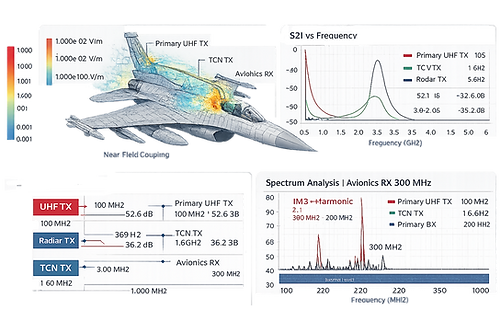
Platform-Level RF Interference Analysis (Co-site Interference)
The interaction between RF systems working together on the platform is analyzed. Transmitter-receiver interaction, frequency clashes, and the impact of unwanted interference on system performance are evaluated during the design phase.
✓ TX–RX interaction and receptor desensitization analyses
✓ Coupling and isolation assessments between antennas and RF systems .
✓ Analysis of intermodulation and harmonic interference mechanisms
✓ Examination of frequency planning and spectrum overlap scenarios
✓ Detection of interference sources using near-field / far-field distributions
✓ Parametric scenario studies and analysis of the most critical configurations
✓ Intrusion mitigation strategies through optimization and sensitivity analyses .
%201.png)
Platform Level EMI/EMC and System Interaction
The cabling infrastructure, electronic equipment, and electromagnetic interactions between structural components are analyzed holistically across the platform. The goal is to control inter-system interaction, propagation, and feedback mechanisms during the design phase.
✓ Analysis of coupling mechanisms between cabling, equipment, and structure
✓ System-level evaluation of conducted and radiated interactions
✓ Identification of EMI propagation paths and critical interaction points
✓ Analysis of cable routing, grounding, and bonding strategies
✓ Evaluation of shielding, filtration, and insulation performance
✓ Investigation of aperture and structural discontinuity effects
✓ Identifying parasitic interactions that occur during system integration

✓ Platform-level pre-validation studies for standards (MIL-STD-461, MIL-STD-464, DO-160, etc.)
✓ Optimization of critical design variables through parametric studies

Power & Signal Integrity and EMI/EMC Applications
Hardware Level SI/PI Analyses
The electromagnetic behavior of high-speed PCBs, multilayer board structures, power distribution networks (PDNs), and critical signal lines is analyzed. The goal is to control signal distortions, power noise, and impedance discontinuities during the design phase.
✓ Signal integrity (SI) analysis (reflection, crosstalk, delay) on multilayer PCBs
✓ Power delivery network (PDN) impedance and resonance analysis
✓ Transient analyses in the time and frequency domains
✓ Impedance discontinuity analyses at vias, connectors and line transitions
✓ Return path and reference plane behavior analysis
✓ Current density and IR drop distribution analyses

✓ Parametric studies (stack-up, trace, via configurations)
✓ Performance improvement through optimization and sensitivity analysis .
Product Level EMI/EMC Analysis
The cabling infrastructure, electronic equipment, and electromagnetic interactions between structural components are analyzed holistically across the platform. The goal is to control inter-system interaction, propagation, and feedback mechanisms during the design phase.
✓ Emission and immunity analyses
✓ Examination of coupling mechanisms originating from cables, connectors, and enclosures .
✓ Shielding effectiveness and leakage analyses
✓ Evaluation of PCB-case interaction and aperture effects
✓ Detection of current distribution and parasitic propagation pathways
✓ Parametric studies and analysis of critical design variables

✓ EMI reduction strategies through optimization and sensitivity analyses .
✓ Preliminary verification studies for standard compliance (MIL-STD-461, DO-160, etc.)

Electromagnetic Environmental Effects
Analysis of the Direct and Indirect Effects of Lightning
Lightning strikes on the platform, direct current injection, and the resulting electromagnetic field propagation are considered together. Critical interaction mechanisms are revealed by analyzing the structural current distribution, transient voltages/currents induced in cabling systems, and equipment-level effects.
✓ Evaluation of effects (lightning zones, waveform A–D) within the scope of exposure levels and waveforms using the zoning approach .
✓ Analysis of structural current distribution, contact points and current return paths (attachment point, strike path, current return paths)
✓ Analysis of induced voltages/currents and coupling mechanisms (indirect effects, cable coupling) in the cabling .
✓ Investigation of transient effects in cable-equipment interfaces and injection scenarios (pin/cable injection)
✓ System-level evaluation of shielding, equipotential bonding, and grounding continuity.

✓ Analysis of flow propagation through structural connections and openings (joints, seams, apertures)
✓ Preliminary verification and strength assessment under DO-160, ARP5412/5414 and MIL-STD-464.
High Field and Electromagnetic Hazard Analysis (EME-2)
In high electromagnetic field environments, the effects of exposure on platforms, equipment, and personnel are analyzed to determine system behavior and safety limits. Critical risk areas are identified by evaluating the propagation of RF fields, coupling mechanisms, and equipment sensitivity together.
✓ System-level assessment of high electromagnetic field (HIRF) exposure
✓ Determining safety distances and exposure limits (HERP, HERO, HERP)
✓ Analysis of the coupling effects of RF fields on the platform and equipment
✓ Investigation of antenna-induced radiation and near-field/far-field behavior.
✓ Determining equipment sensitivity and functional impact levels.
✓ Analysis of the effects of EMP and high-energy pulse environments on system resilience.
✓ Preliminary verification against standards (MIL-STD-464, DO-160, STANAG, etc.)
.png)
✓ Mapping the distribution of field density (E/H field) in critical regions
Magnetic Signature Analysis
The total magnetic signature is characterized by analyzing the permanent and induced magnetic signature components resulting from the platform's interaction with the Earth's magnetic field. Structural and system-related contributions are separated, and the goal is to minimize the signature level through degaussing strategies.
✓ Analysis of permanent and induced magnetic field components (permanent/induced magnetization)
✓ Decomposition of magnetic additives originating from structural materials and equipment
✓ Determination of magnetic field distribution and magnetic signature level
✓ Analysis of the effectiveness and current distribution of degaussing systems
✓ Investigating the magnetic interactions of sensors, cabling, and power systems.

✓ Magnetic field intensity (B-field) mapping in critical regions
✓ Evaluation of track changes depending on platform configuration and operational conditions .

Multi-Physics Applications
Hardware Level Electrothermal and Thermomechanical Analyses
Electrical losses, thermal behavior, and structural effects are evaluated together to determine their impact on performance, reliability, and lifespan at the hardware level. DC conduction, Joule heating, and associated thermal dissipation deformations are analyzed in an integrated manner.
✓ Analysis of DC current distribution and transmission losses (DC conduction, IR losses)
✓ Evaluation of the electrothermal temperature distribution caused by Joule heating.
✓ Performance analysis of thermal diffusion and cooling mechanisms
✓ Investigation of temperature-induced mechanical stress and deformation (thermal deformation)
✓ Evaluation of temperature-dependent changes in material properties
✓ Analysis of flow propagation through structural connections and openings (joints, seams, apertures)

✓ Temperature and current density (hotspot) detection in critical areas
✓ Determining the equipment's durability under electrical and thermal loads .
Electromechanical System and Power Electronics Interaction Analyses
System behavior, performance, and durability are analyzed by considering the interaction of electromechanical components with power electronics circuits and the thermal-fluid environment. Critical design parameters are determined by considering electrical, magnetic, thermal, and fluid effects in conjunction.
✓ Analysis of the electromagnetic behavior of electromechanical components (motors, actuators, etc.)
✓ Evaluation of current, loss, and switching effects in power electronics circuits
✓ Mapping the distribution of field density (E/H field) in critical regions
✓ Determining the effects of magnetic saturation on losses and efficiency.
✓ Coupled analysis of electromagnetic, thermal, and fluid fields.
✓ Investigation of cooling performance and flow field behavior
✓ Evaluation of performance changes caused by temperature and current .

✓ Performance and efficiency optimization through parametric studies

Other Applications
Radar Signal Processing (Range-Doppler, Detection)
Target detection, speed, and distance discrimination are achieved by analyzing the behavior of radar signals in the time and frequency domains. Range-Doppler processing is evaluated to reveal the signal separation performance under noise and clutter effects.
.png)
Radar/RF Scene Modeling
The electromagnetic radiation and reflection behavior is modeled by considering platform, environment, and target interactions together. System performance is analyzed under realistic operational conditions by evaluating multiple reflections, shadowing, and environmental effects.
.png)
Metamaterial and FSS-Based Structures
The filtering, steering, and attenuation behaviors of metamaterials and frequency-selective surface (FSS) structures that control interaction with electromagnetic waves are determined by analysis. The effects of material properties and geometric parameters on RF performance are evaluated together.

Electrical Charge and Static Effects (RF Discharge and ESD)
The filtering, steering, and attenuation behaviors of metamaterials and frequency-selective surface (FSS) structures that control interaction with electromagnetic waves are determined by analysis. The effects of material properties and geometric parameters on RF performance are evaluated together.
.png)
The images used are for illustrative purposes only and do not contain any actual data from any project.
